
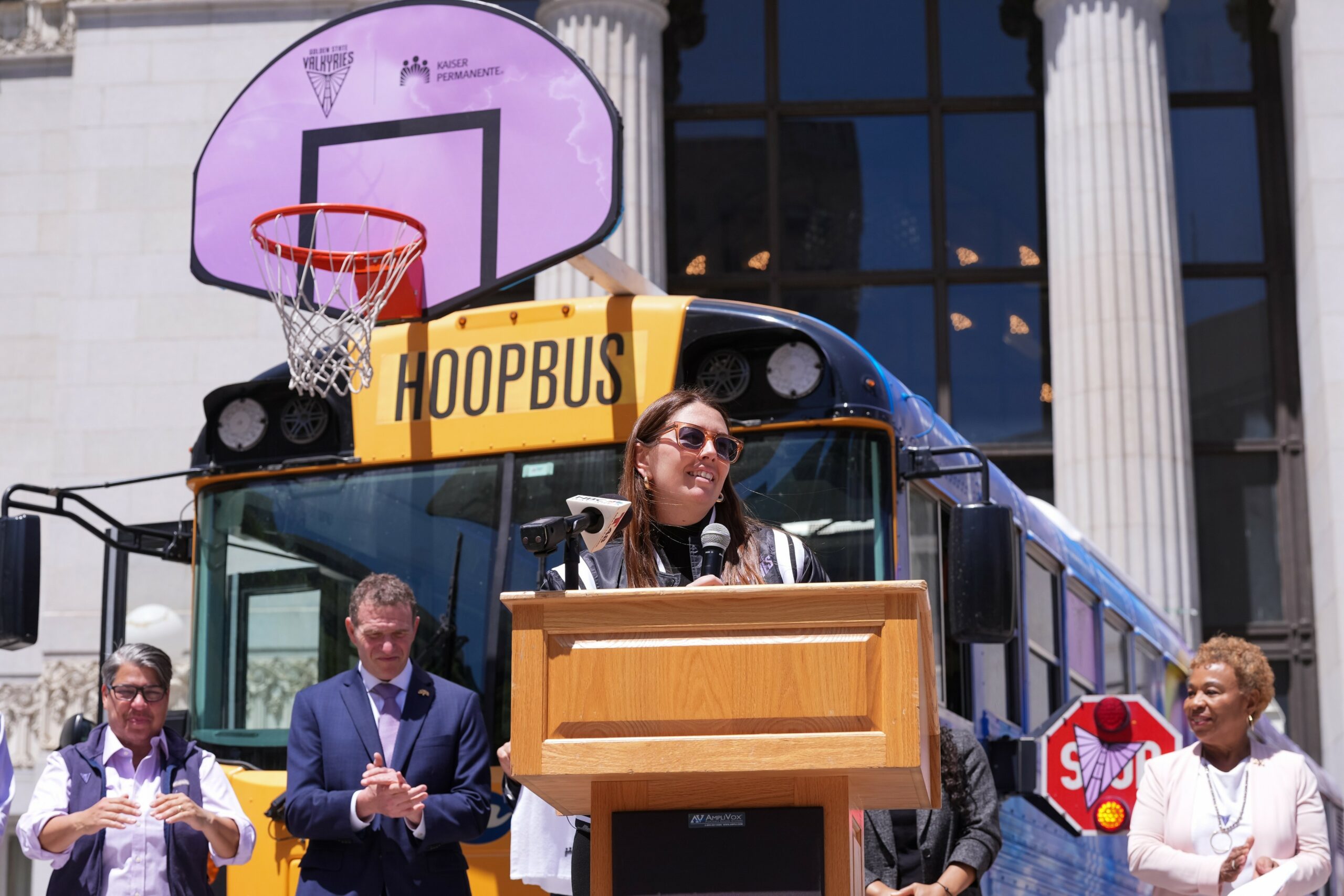
The team has also built a brand that extends far beyond the Bay Area. Its connection with France is particularly strong, led by Gabby Williams, one of the most recognizable French players in the WNBA and a key figure for the French national team. Alongside Janelle Salaün and Iliana Rupert, she gives the Valkyries a natural bridge to French fans and to a wider European audience.
Building the Golden State Valkyries identity
A shared vision
When Jess Smith first met Joe Lacob and Peter Guber, the owners of the Golden State Warriors and the Golden State Valkyries, the new franchise had not yet played a single game. When asked about what the Valkyries had achieved in two years – a trajectory that other franchises sometimes take a lifetime to reach – Smith did not start with the records. She returned to that first conversation with the owners. “What always sticks out to me about that conversation is how curious they were. These are two prominent businessmen, both in entertainment, in venture and in finance, and obviously in building the Warriors and Chase Center into a global brand. They were asking me: ‘How did you do it at Angel City? What do you think we should do? Why do you think this moment matters?’ They weren’t necessarily looking for me to have a specific answer. They were looking for guidance.”
The conversation focused on a vision to be built together. Smith also saw in it a particular approach to leadership: surrounding yourself with expertise capable of improving the project. “That sticks out to me also as a leader myself, of wanting to make sure I’m replicating that with the experts around me to give us the best product. That conversation did not lack passion. Angel City was hard and it was a true startup. We had to completely switch how we were talking in the market and bring the right attention to it. We had to work really hard and have the right resources to make that successful.”
The level of ambition was clear from the outset. “There was a shared commitment that this was what they wanted to do. They wanted to give us the right capital to make it great. The question was: what’s the roadmap to get that done?”
Telling the story first
When she arrived, Smith identified two immediate priorities. The first was the brand. Some of the work had already begun before she was hired: research, data, an external agency and discussions around the name, colors and logo. “There were two main things to get done right away. To be fair, we had a lot of work being done even before I got there to get us into the right journey when it came to the brand. Who are we going to be? How are we going to identify? They had done surveying, data and hired an external agency. They were beginning to have conversations around different ways that we could build this brand, with the team’s name, the colorway and the logo. That’s important because it says so much about who you are.”
The second priority was communications. Jess Smith immediately hired an external agency and a senior vice president of marketing and communications. “One of the most important things people sometimes don’t realize in sports is that you need to be able to tell your story to the right people at the right time and get enough attention to affirm the decisions and the good work that you are doing.”
For the Valkyries president, communications do not come after the product. They are part of its construction. “You can do a really good job at building things and have intent behind it, but if you can’t tell those stories and have them shared the way they should be, to garner fandom and consumer trust, it doesn’t matter. So even when we didn’t have employees and our brand was not fully there, we needed a comms team to be along with us on this journey, so that as we started to set those little stones out in the marketplace, as to where we were going to go with this, and candidly, to prepare for if things didn’t go well, you need your communications team.”
This approach leads back to a simple business equation: generate revenue and acquire consumers. “It’s no different than any other business. What are you looking to do as a startup? One, you’re looking to drive revenue. Two, you’re looking to acquire fans or acquire consumers. You need people to be part of this with you. So outside of telling the right stories and getting the brand right, how are we actually building a system and a culture that are doing the other two? We need fans, we need revenue, they’re going to inspire and create better opportunities together, but most importantly, they’re going to build a better tomorrow in women’s sports.”
A brand visible everywhere
The franchise is the WNBA’s first expansion team since 2008. To enter the market successfully, it first had to build awareness. The purple colorway, the logo and Violet, the mascot, became visibility tools. “We had to bring the WNBA to this market and to the world in epic fashion as the first expansion team since 2008. Part of that is awareness. People may know of the WNBA, but maybe they are not engaged. And people may not know about the WNBA at all. We wanted to approach it that way.”
The color had to make the team identifiable before someone became a spectator, customer or viewer. “How can we be recognizable, like any brand would look to be? Even in the color, you would know that we existed. We have to earn that market share before people come to our top of funnel, before they buy merchandise, attend a game or watch us on television.”
That effort takes place throughout the city and in familiar spaces. “We need to be out in the community. They need to see us in familiar spaces. We can’t expect them to come to us if we aren’t going to them. We really think about that often.”
Before the season began, the franchise had recorded more than 17,000 season-ticket deposits. Less than 5% of those deposits came from Warriors season-ticket holders, according to data published by The Athletic in fall 2024. Demand was therefore built around a new story, new codes and a new culture.
Ballhalla: a shared culture
That culture has a name: Ballhalla. The term does not merely describe a campaign, an activation or the name of the Chase Center experience. It reflects the franchise’s ambition to create a space that extends beyond the arena and connects with the diversity of the Bay Area. “Ballhalla is more than a campaign or a name for the arena. It is a culture. It is a way of bringing people together and creating a space that feels welcoming to everyone. We wanted something that could speak to people who already love basketball, but also to people who are discovering the WNBA for the first time.”
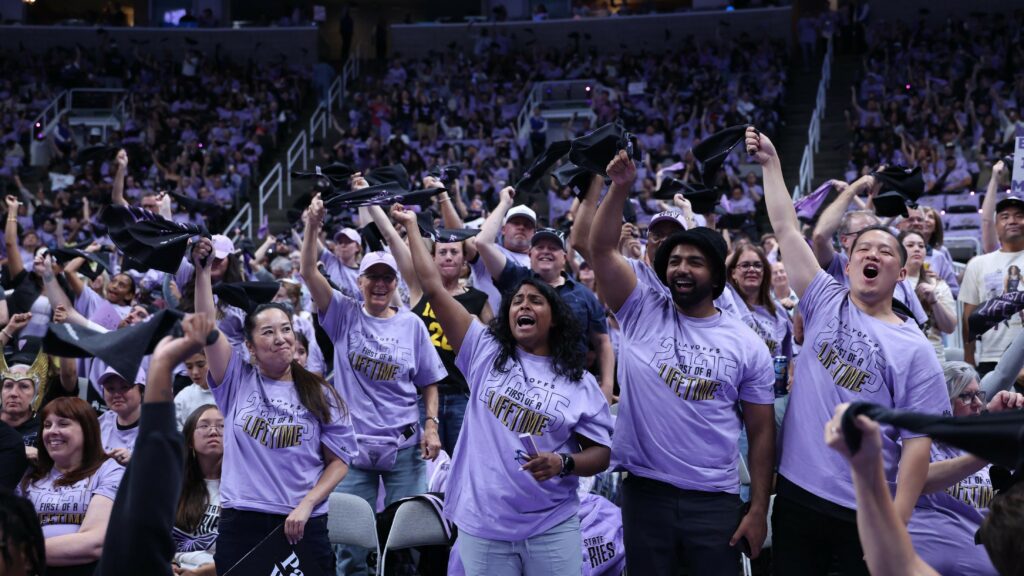
The Ballhalla culture inside Chase Center – Photo : Getty / Golden State Valkyries
Ballhalla is built around inclusivity and representation. It reflects the Bay Area’s diverse communities and is designed to welcome women, people of color and LGBTQ+ fans. The culture is community-first: it is driven by shared joy, collective energy and the feeling that the crowd itself becomes a sixth player during games. The franchise also brings local identities into the arena through heritage nights, including Filipino and Polynesian celebrations, connecting the team to the cultural fabric of its territory.
“It can live inside the Chase Center, but it can also live in our content, in our community work, in our partnerships and eventually in different places around the world. We wanted to create something that people could recognize and feel part of, whether they are at a game, watching from home, following us online or experiencing the team somewhere else.”
Ballhalla therefore creates continuity between the game, social media, merchandise, community initiatives, heritage celebrations and partner activations. It is both a place and a state of mind: a way for fans to recognize one another, connect with the team and build relationships around women’s basketball.
Growing beyond the building
Chase Center is already full
During their first season, the Valkyries sold out all 22 home games at Chase Center. They attracted 397,408 spectators during the regular season, with an average of 18,064 fans per game, setting WNBA records for total and average attendance. The team has since surpassed 40 consecutive sellouts.
Growth can no longer come from additional seats. It has to come through the experience, the product mix and the value created beyond the arena. Accessibility remains an essential principle. “It’s always a balance. Our job is to create a product that meets the demand for these incredible athletes and our game-day experience, and the ticket price will always reflect that. Accessibility is important for sure, but there are also ways that aren’t affiliated with ticket prices that impact that. We donate a significant number of tickets each game. The pricing is still something that allows people to join us if they would like to, without price being the main factor.”
Jess Smith distinguishes between two products. The first is the game-day product, with its ticketing, food and beverage, merchandise and hospitality revenues. “We have two products. We have our ticketed product, which is game days. It is incredibly important and it has to create that kind of FOMO. Whether you’re watching from New York or watching from France, you want to go there, right? We need that to continue to remain epic, as fans continue to bring it to life within the walls of Ballhalla”
“Within those walls, our job is to drive revenue through food and beverage, merchandise and then certainly the ticket prices themselves. We have to continue to create demand to do that. There is a balance in all of those things.” Themed events reinforce that experience. Hello Kitty night generated record merchandise sales, surpassing the inaugural game. “We had a Hello Kitty night this year. We had record-breaking merchandise sales, even more than at our inaugural game, because we were prepared for it, we planned for it. It was something that was new and exciting and one of a kind that our fans wanted to be a part of.”
The season offers several opportunities to create these moments. “We have 23 opportunities to do that, 26 next year, as well as the playoffs. Our marketing team is hard at work figuring out what those moments are that allow us to really maximize our game days far beyond a typical game day.”
The second product concerns everyone else: those who may never attend a game, who live elsewhere in California or abroad. “The second product for us, and one that will continue to remain a focus, is everyone else: the people who may never attend a game, the people who have never come to San Francisco, who live somewhere else in California or somewhere else in the world.”
“What is that experience like, and how are we still creating value for fans who choose to follow us on social media or watch all of our content? We get to leverage that through media partnerships, partnership dollars and resources as well. We are constantly thinking about and investing in that side of our business, because that is going to continue to draw more attention and eventually can be equal parts of how we drive our business and the revenues associated with it.”
An opening toward France
This second dimension naturally creates space for international growth. France is a specific market for the Valkyries, who have Gabby Williams and Janelle Salaün on their roster, both selected for the 2026 All-Star Weekend. Iliana Rupert, on maternity leave this season, is the franchise’s third French player, while Carla Leite joined Portland during the offseason.
“We now have the opportunity through the league to begin to activate internationally. We can do that up to three times a year. We certainly have our eyes on France, given the reason that you shared. We have some following from there.”
If WNBA Commissioner Cathy Engelbert has publicly discussed the league’s interest in staging games abroad, opportunities for the club could include a tour, a preseason game or activations designed to build a local community.
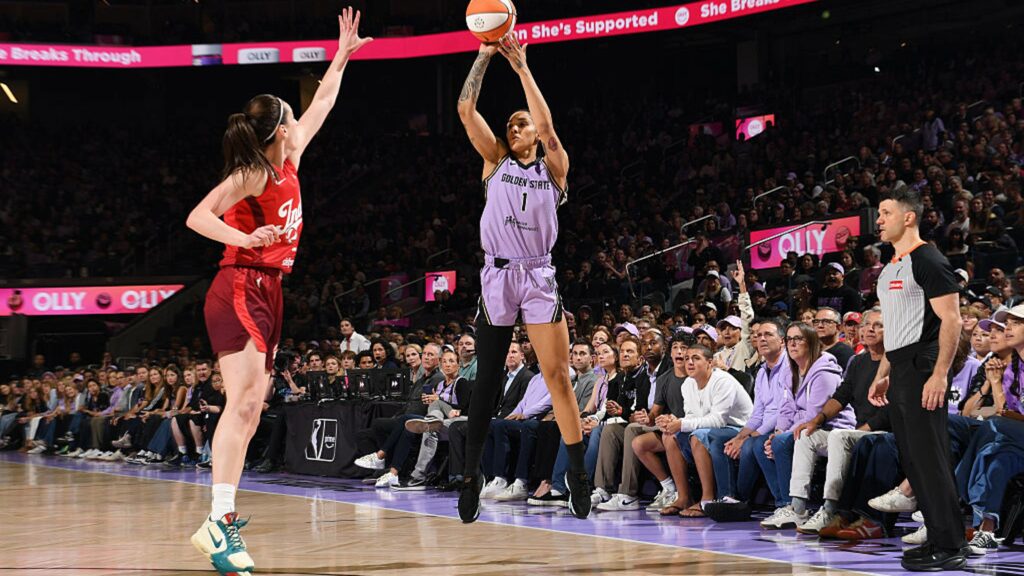
Gabby Williams, Golden State Valkyries – Photo : Getty / Golden State Valkyries
“We have incredible athletes on our team who have allowed us to build a following. Candidly, we also feel a kinship with France, which is often so culturally relevant and in front of so much, whether it’s fashion or sport or different opportunities to express oneself. We feel there are a lot of similarities from an organization and a market standpoint.”
“Preseason games in other countries could be activation opportunities, whether they are basketball-related or not. You are starting to see NFL and NBA teams create whole staffs that are fan-focused, not necessarily around basketball, but around other countries. I think for us, you could expect to see some of that thinking start to come to fruition soon.”
International growth is therefore part of the same commercial development strategy. It extends the second product Smith describes: the relationship with fans who are not in the arena. That audience broadens the reach of the team’s content, partners and players’ stories.
Partnerships as a platform for growth and impact
Partners building with the franchise
This community-based approach also shapes the partnership strategy. For Jess Smith, the value of a deal goes far beyond visibility. “Partnership is so much more than signage and media. Partnerships are about focus. They reflect your brand and you reflect their brand. They’re people that you are building beside, creating fandom, deepening fandom and creating results for what they have on tap and what you have on tap.”
The relationship works both ways. Partners benefit from the Valkyries community, while their commitment contributes to the franchise’s visibility and development. “There is a deeper level of connection to understanding and appreciating the financial support of women’s fans. If a partner is a jersey partner, fans actually appreciate that and want to support that brand because they know they are supporting the thing they love the most, the growth of it and, of course, the world and seeing a more equitable future.”
To build these agreements, the franchise first had to define its own identity. “Partnerships are not one-size-fits-all. You have to understand who you are. When I got to Golden State, there were brands saying, ‘Let’s talk,’ including brands I knew from the partnership world and brands associated with the Warriors or Chase Center. I said no. We need to figure out who we are, what it means to be a partner and how we are going to build this together.”
The Impact Council: keeping the course
This requirement for coherence led to the creation of the Impact Council. It brings together the Valkyries’ founding-level partners four times a year: CarMax, JPMorganChase, Kaiser Permanente, OLLY, Pacific Gas and Electric Company, Rakuten, Sephora, United Airlines and Waymo. The Council gives partners a framework for sharing expertise and thinking collectively about the development of women’s sports. “The job of the Impact Council is to understand that we have a lot of influence and data behind the collective. We are not going to say that we have everything figured out about where women’s sports is going and how to make sure it is beneficial for business growth. We are going to do that together and have honest conversations.”
The Council does not replace each partner’s own strategy. It creates a framework for coherence and cooperation. “Each one of them has to trust that they are going to get the results and the value they need. From a partnership perspective, that means you have to be ready for that. You need a great service team, a data and analytics team, and you need to understand who you are so you can pitch the right brands about what the partnership is going to be, not just pitch media assets. Fans want to know why you are together. Why do you show up every day? Where is that shared value alignment?”
Impact built into the model
At Angel City, Jess Smith had developed the 10% model to make impact visible from the very beginning of a partnership. “The 10% model at Angel City was so important at the time. We were going out to brands and there was often a charitable component to why they would consider a partnership, rather than saying: this is what it costs, this is going to be great and, by the way, we are also going to make that impact.” The market has since matured. The objective remains, while the mechanisms have evolved. “At the Valkyries, we have the same mindset, especially with our founding-level partners. That ‘why’ comes together to make sure we are not losing sight of it.” Two partnerships illustrate this approach.
Kaiser Permanente contributes $25 for every jersey sold to the Golden State Community Foundation to support « She Plays On », a platform that helps keeping girls in sports
“Kaiser Permanente works in healthcare. After a listening tour of over 100 people — coaches, city officials and teachers — we asked where they would want us to do good work together. They said: keeping young girls in sport. They came to the table and said that 25 dollars from each jersey sold would help do just that. Not only can the players wear that jersey with pride, but as a consumer, every time you buy it, you can feel that you are helping. We just announced that, from year one, that has generated more than 400,000 dollars.”
The jersey becomes a funding and engagement vehicle. Players wear it with pride, and fans buy it knowing that part of their purchase contributes to a concrete program.
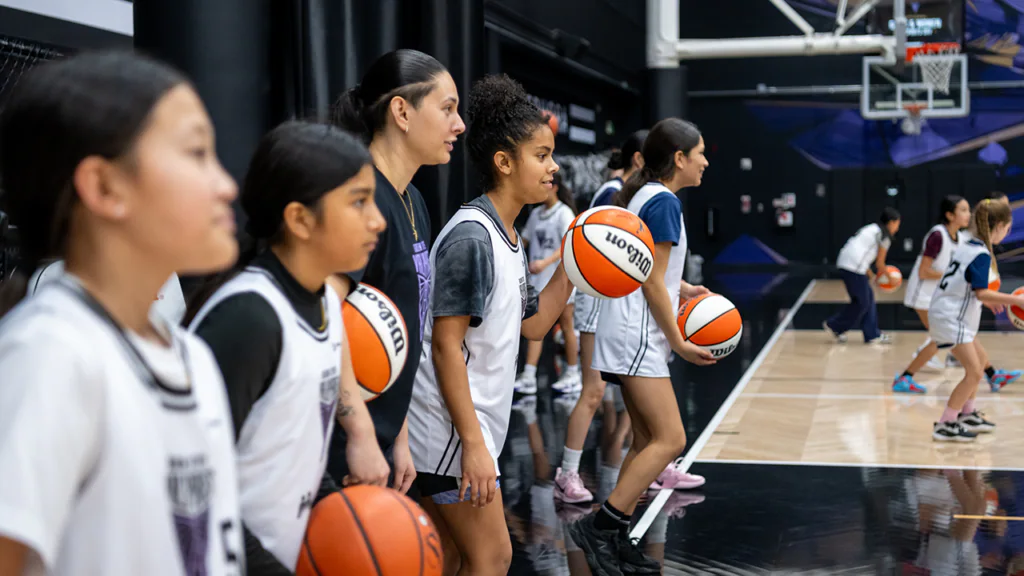
She Plays On, a platform of the Golden State Community Foundation designed to keep girls in sports and supported by Kaiser Permanente. Photo : Golden State Valkyries website
JPMorganChase, the franchise’s first founding partner, focuses on small businesses, diverse business owners and access to resources. That is the purpose of the Violet Book of Business.
“Chase is about making sure that we think about small businesses, that we talk about diverse business owners and provide resources. We have the Violet Book of Business, where we bring 15 to 20 businesses together for week-long programming, coaching and community. They are compensated for being part of it, they receive training and resources, and they get visibility because we talk about their businesses on social media. We also have a pitch day where one of them wins and receives more funding and visibility going into the next year. We are walking the walk with those partners and staying deeply connected to our community together, with actual funds. You can say that you need something, but actually putting funds behind it makes a big difference.”
With Kaiser Permanente, the partnership turns a product into funding for girls’ participation in sport. With JPMorganChase, it turns the Valkyries platform into a resource for local entrepreneurs. Both examples translate Smith’s philosophy into concrete programs, built with partners, rather than simply displaying their brands.
What the $1 billion valuation really means
The billion-dollar marker
This progressive construction has quickly been recognized by the market. The Valkyries generated approximately $78 million in revenue during their inaugural season, a WNBA record according to published estimates. Their season-ticket base also grew from approximately 10,000 to 12,000 for the 2026 season, alongside a price increase. According to CNBC, the franchise became the first women’s sports team to reach a $1 billion valuation. Smith places that valuation within a broader trajectory: a league moving to a new scale and a market that is only beginning to reveal its potential.
“I did expect it. I have been in women’s sports and had a true pulse on it since Angel City for six years now. I understand how steep this growth trajectory is. We are just scratching the surface on what’s possible. In the WNBA, we are expanding the schedule, we have a new CBA, a new media deal, growth in infrastructure and healthy expansion teams coming into the league. A lot of factors outside of who we are also contributed to that valuation.”
“For us, we have an incredible team and an incredible fan base that has pushed our revenue to the point that this is a respected valuation. I am excited that we were the first, but I expect many women’s sports teams to be valued at over a billion dollars. I feel honored to have been part of the franchise that did it first, but it is really about what this means for the future.” The billion-dollar figure is therefore a signal. It reflects the speed of the market’s evolution and the recognition of the Valkyries project. It does not, on its own, explain the model.
The next phase
The next phase of growth will be built through the value of the game-day experience, relationships with fans who follow the team from a distance, content, international activations and long-term partnerships. The Golden State Valkyries began by sharing a vision, defining an identity and telling a story. They turned that story into demand, revenue and lasting relationships with their community and partners. The billion-dollar valuation is one marker along that trajectory. The next chapter will depend on the franchise’s ability to make Ballhalla live beyond game day, develop its international audience and continue creating value for fans, players, brands and the Bay Area.